Perception
Terminological clarification
In this framework, the term spiritual does not oppose material, nor does it refer to any religious doctrine. It is used in functional opposition to the term mental.
- The mental pertains to the biological brain: learning, conditioning, memory, language, culture—in short, everything that is acquired and modified through experience.
- The spiritual pertains directly to CELA (the substance of the Real): it designates fundamental orientations of the relationship to reality, independent of specific cultural or psychological contents.
Thus, the spiritual mentalities described here are neither psychological states nor personality profiles. They are ways of giving meaning to experience, present prior to any mental, cultural, or ideological elaboration. This distinction explains why people from very different cultures may share the same spiritual orientation—and conversely, why individuals from the same culture may inhabit the world in radically different ways.
Origin of spiritual mentalities
Observation suggests that certain combinations of fundamental perceptions give rise to stable ways of giving meaning to experience.
How meaning is formed
Our perception of the world is organized along several dimensions:
- The intensity of what presents itself (how important, strong, or present it is)
- Qualitative sensation (how it is felt)
- Configuration (who/what is present, identifiable forms)
- Transition (actions, changes, states, possession, passages from one state to another)
- Relationships between things (links, interactions, dependencies)
- Principles organizing the whole (laws, coherences, reflexive structures)
Each dimension contributes something distinct. However, we do not process all dimensions in the same way. Depending on our configuration, some become central in how we understand the world.
Three naturally stable combinations
Among all possible combinations, three prove particularly stable. They correspond to three fundamental ways of closing meaning—that is, transforming raw experience into something intelligible and meaningful:
- Operative sense: Combines intensity/value and principle → Understanding by seeking reason, law, or logic that explains
- Relational sense: Combines sensation and relation → Understanding by feeling connection, unity, interdependence
- Structural sense: Combines object/subject and action/transition → Understanding by identifying who acts, who possesses, who occupies which position
These three senses do not describe opinions, cultural contents, or personal choices. They describe perceptual composition modes—distinct ways in which the Real can be given to perception.
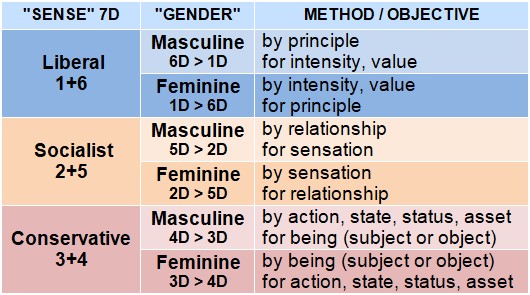
Each access path to the systemic level (D7) relies on a pair of lower dimensions, forming a particular style of discernment of the Real. These styles are not purely cognitive: they involve a way of being in the world, a way of feeling problems, seeking solutions, and evaluating what truly matters.
That said, although the three sensitivities contemplate the same systemic realities, they do not perceive them through the same faculty. They therefore do not experience the same perception, are not sensitive to the same problems, and do not envision the same solutions. A striking example of divergence lies in the content of the 7D mystical experience.
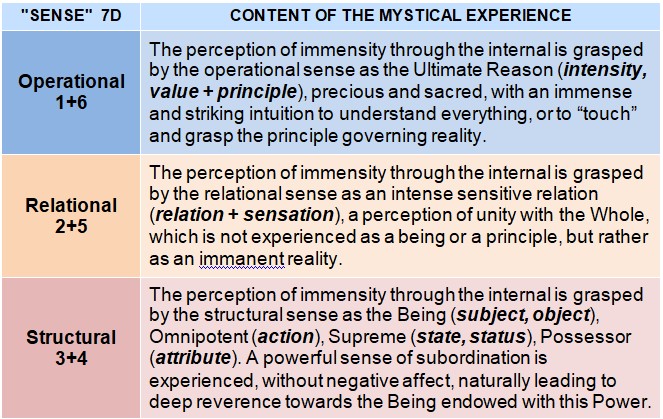
Likely arising from an internal perception of CELA, the content of this experience at the 7D level is largely conditioned by the compositional perceptions of the mystic’s three seventh-level spiritual senses according to their mentality. All degrees of mixture are possible, giving rise to every kind of doctrine. For example, the operative mentality will judge that God is in everything only if its relational sense is sufficiently strong; failing that, it will often presume God to be external to creation.
These three types therefore do not exclude one another. They coexist within each of us in varying degrees, but one sensitivity generally tends to dominate. In some cases, an integrative 8D experience may illuminate the value of these systemic perceptions—an experience capable of radically transforming a mental belief system.
That said, these three orientations do not structure only the 7D mystical experience. They organize how we approach ordinary situations, daily decisions, and interpersonal relationships.
Example 1: Observing an approaching storm
Three people watch the same darkening sky, hear the same thunder, feel the same humidity. The base experience is identical. But what they perceive as central differs:
-
Operative person: “It’s magnificent—so much power governed by relentless thermodynamic laws. You can understand how convection creates these storm cells.”
→ Perceives necessity and logical structure -
Relational person: “I feel an immense presence, as if the atmosphere were alive. There is unity between me and this force.”
→ Perceives connection and unity with the phenomenon -
Structural person: “What power. This storm dominates the territory—it asserts its force. You can sense it could destroy or spare.”
→ Perceives the acting entity and its territorial supremacy
All three observe the same storm. But one sees a system, another a presence, the third a force. What occupies the experiential center diverges: principles, lived connection, or entities and positions.
Example 2: Team meeting about reorganization
The announcement is the same for everyone: “We are reorganizing departments.”
-
Operative person: “Is this reorganization coherent with our objectives? What is the optimal system?”
→ Seeks principle and decision logic -
Relational person: “Will this destroy the trust we’ve built together? How do we preserve the bonds?”
→ Feels the relational and emotional impact -
Structural person: “Who is really deciding? Does this threaten the stability of established roles?”
→ Identifies entities, power, and positions
Each perceives a real aspect of the situation—but through different modalities. The operative does not spontaneously feel relational impact. The relational does not spontaneously see power structures. The structural does not spontaneously grasp optimal logic.
Example 3: Political debate on immigration
-
Operative person: “Data shows skilled immigration increases GDP. The principle is economic efficiency.”
-
Relational person: “We must welcome those who suffer. Our shared humanity creates an obligation of solidarity.”
-
Structural person: “Mass immigration destabilizes national identity. Institutions must protect social coherence.”
None of these positions is “false.” Each perceives a real dimension of the problem—economic efficiency, human suffering, institutional stability. Conflict does not arise from ignorance or bad faith, but from fundamentally distinct perceptual compositions.
These differences are not:
- ideological choices
- intelligence deficits
- moral failures
- cultural biases
They are structural configurations of perception. The operative cannot “decide” to feel like the relational. The relational cannot “learn” to perceive like the structural. Each inhabits the world through a perceptual composition proper to them.
Spiritual genres
We have seen how three fundamental spiritual sensitivities—operative, relational, and structural—emerge from the combination of perceptual dimensions. Each sensitivity can manifest through two distinct polarities, termed masculine and feminine, not in a biological or social sense, but in their perceptual orientation.
The terms masculine polarity and feminine polarity designate two complementary orientations of consciousness. They describe neither social roles nor gender identities nor biological characteristics. They name directions of relationship to the Real: one descending (masculine), the other ascending (feminine). Each person may express both orientations in varying proportions, independently of sex or gender.
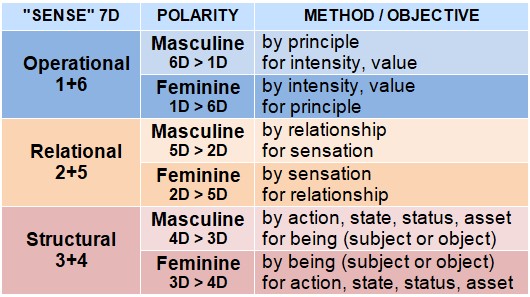
By combining three senses and two polarities, eight configurations would be theoretically possible. However, purely masculine (MMM) or purely feminine (FFF) configurations are not attested in the examined corpus at this stage.
Stable configurations follow a 2+1 principle:
- Spiritual masculine: 2 senses with masculine polarity + 1 sense with feminine polarity
- Spiritual feminine: 2 senses with feminine polarity + 1 sense with masculine polarity
Depending on which sense carries the minority polarity, six configurations emerge:
| Spiritual genre | Operative (S1) | Relational (S2) | Structural (S3) |
|---|---|---|---|
| Spiritual masculine | |||
| Variant 1 | Feminine | Masculine | Masculine |
| Variant 2 | Masculine | Feminine | Masculine |
| Variant 3 | Masculine | Masculine | Feminine |
| Spiritual feminine | |||
| Variant 1 | Masculine | Feminine | Feminine |
| Variant 2 | Feminine | Masculine | Feminine |
| Variant 3 | Feminine | Feminine | Masculine |
Structural note: Opposed configurations (masculine variant 1 ↔ feminine variant 1, etc.) invert all polarities, creating a remarkable complementarity that manifests notably in relational and affective dynamics.
Balance, stability, and singularity
Some perceptual configurations show strong dominance of one sense, while others present a more distributed presence of all three.
When one sense strongly dominates, it often results in exceptional acuity within that register: great clarity in manipulating principles, unusual relational depth, or fine understanding of structures and positions.
This acuity is generally accompanied by zones less directly accessible in other registers—not due to deficit, but due to reduced perceptual salience. Below is an AI phenomenological analysis of these “imbalanced geniuses” and their “madnesses” (blind spots), based on sense definitions.
1. Operative Genius (Hyper-S1): The “Mad Scientist”
Gift (90% S1): Perceives the world solely as abstract Principles and Values. Sees the matrix, underlying equations, invisible coherence.
“Madness” (S2/S3 blind spot):
- S2 blindness: emotional coldness, inability to feel human suffering
- S3 blindness: contempt for authority, status, or material constraints
Social diagnosis: “detached,” “autistic savant,” “ivory tower intellectual.”
2. Relational Genius (Hyper-S2): The Enlightened One / Wounded Artist
Gift (90% S2): Perceives the world as pure Relation and Sensation. Feels unity and immanence.
“Madness” (S1/S3 blind spot):
- S1 blindness: rejection of logic and structure
- S3 blindness: inability to manage limits, hierarchy, money, or boundaries
Social diagnosis: “naïve,” “dangerous utopian,” “delusional mystic.”
3. Structural Genius (Hyper-S3): The Conqueror / Grand Administrator
Gift (90% S3): Instantly perceives power, structure, leverage, hierarchy.
“Madness” (S1/S2 blind spot):
- S1 blindness: efficient but absurd systems
- S2 blindness: treating humans as resources or objects
Social diagnosis: “tyrant,” “cold psychopath,” “control-obsessed.”
Balanced configurations allow broader situational reading, at the cost of reduced intensity in each register. If genius is a telephoto lens sacrificing field for precision, balance is a wide-angle lens sacrificing sharpness for completeness.
The genius is dogmatic because vision is so clear it cannot imagine partiality. The balanced profile is tempering: seeing all three senses simultaneously, it perceives how each limits the others.
Its product is not a “super-science,” but a super-consciousness of complexity.
The fundamental orientation—spiritual mentality and spiritual genre—is neither acquired nor modifiable by education, will, or training. It does not arise from learning, culture, or personal history. It is constitutive: present from origin, as the manner in which the Real closes, stabilizes, and becomes meaningful for an individual.
In this framework, we do not possess a spiritual mentality: we are that configuration.
The CdR framework proposes that these configurations belong to consciousness itself, independent of any particular biological organization. This position and its implications are developed later, following progressive exploration of physics, cosmology, astrophysics, chemistry, biology, and the nervous system.
One may learn, evolve, develop compensatory skills, or rebalance proportions—but one does not change their fundamental configuration nor their way of inhabiting the Real. Attempting to do so would not be evolution, but inner dissonance—or the imposition of a form that is not one’s own.
This singularity grants each person natural aptitudes and less accessible zones. No one perceives everything; no one experiences reality in the same way.
This diversity makes human relations both rich and difficult. What is obvious to one may be opaque to another.
Recognizing one’s own inner style enables greater self-understanding. Recognizing that of others enables listening, acceptance, and collaboration without forcing uniformity.
No way of being is superior to another. They complement one another as different ways of opening the Real.
According to this model, diversity of existence is not an obstacle to unity—it is its living condition.
Ontology and perceptual balance
How mentalities produce worldviews
Major philosophical visions of the Real—materialism, idealism, panpsychism, dualism—are not errors. They are focalizations on certain dimensions of experience. Their limitation lies not in what they see, but in what they do not see.
Plato (operative dominant)
→ Captures logical coherence and intelligibility
→ Blind spot: body, matter, affect
Bergson (relational dominant)
→ Captures lived duration and intuition
→ Blind spot: objective structure and law
Democritus (structural dominant)
→ Captures entities and causality
→ Blind spot: qualitative relations and emergent principles
| Imbalance | Ontology | What it sees | Blind spot |
|---|---|---|---|
| Hyper-S1 | Rational idealism | Principles, laws | Body, affects |
| Hyper-S2 | Relational panpsychism | Unity, lived relation | Structures, abstractions |
| Hyper-S3 | Reductionist materialism | Entities, mechanisms | Subtle relations |
| Balance | Psychophysical monism | Principles + relations + structures | Minimal |
Ontology vs perception
Individually, each person inhabits a stable configuration. Configurations perceiving all three senses with equal clarity appear extremely rare.
Ontologically, a complete description of the Real should recognize all three dimensions as equally real and complementary.
Conceptual explanation does not equal direct perception. Understanding that a cylinder exists does not mean perceiving it volumetrically.
If complete perception is inaccessible individually, it may become attainable collectively, through complementary viewpoints.
Limits and open questions
- Do balanced configurations truly perceive more completely, or simply differently?
- Can conceptual understanding approximate perception through training?
- Can collaboration between configurations produce more than compromise?
The CdR framework remains falsifiable. Clear counter-examples would require revision.
Revealing spiritual mentalities and genres may provoke legitimate disturbance. It questions assumptions and may render meaning fragile or incomplete.
Yet this framework removes nothing from lived reality—it reveals its richness and plurality. And if it challenges the mental, there is no reason for existential or metaphysical anxiety:
there is nothing more spiritually fulfilling than reality itself.
Further reading
To go deeper into the origin of spiritual mentalities, spiritual genres, and the collective reconstruction of a more complete form of truth:
- image012 — Perceptions — operational, relational, and structural senses
- image013 — Perception — Content of Mystical Experience According to the 7D Senses
- image014 — Cross-Validation by Artificial Intelligences — Descriptive Scope and Limits
- image015 — 7D senses and polarity — Spiritual genres
- image016 — From partial perception to the solution form
These documents develop the perceptual triad S1/S2/S3, its polarities, its effects on mystical experience, and its methodological extensions in the collective reconstruction of a more complete reading of the Real.