Physics
The sections that follow do not seek to replace modern physics, but to show that its fundamental structures — constants, spectra, symmetries — can emerge as necessary solutions of a coherent substrate. This work explores how a single geometric principle can give rise, without arbitrary tuning, to phenomena that resemble those of the Standard Model.
In other words, the goal is not to say “what happens” in the world, but to show how the world could describe itself from its most fundamental conditions of existence. Physics retains its experimental, predictive, and quantitative role; what is targeted here is the generative structure that makes these forms possible.
This approach could also shed light on certain open questions in theoretical physics, such as the origin of fundamental constants (for example h, c, G, or the fine-structure constant α), the mass hierarchy, the nature of gravity, dark matter, or the stability of quantum states across different scales. In this framework, these phenomena are not arbitrary given facts about the world, but structural effects of the way CELA complexifies while preserving internal balance between density and differentiation.
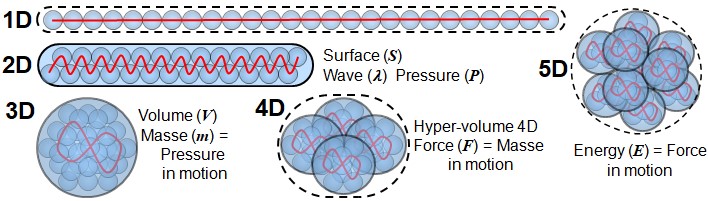
We will focus primarily on the constituents of ordinary matter: quarks, leptons, and the interaction carriers (bosons). But the aim is not to explain physics from CELA; rather, to show that physics can necessarily emerge from a process of self-complexification governed solely by the fundamental attributes of the substance of the real.
Thus, what follows does not describe the world: it shows why the world can be as it is.
Further reading — Full physics corpus (017–069)
The CdR Physics domain relies on a structured set of images and technical documents forming a coherent path, from the fundamental formalism to advanced quantum phenomena.
-
image017 — The Standard Model of Physics — a minimal map of the interactions of ordinary matter
-
Fundamental Structure (006, 018–022)
- image006 — Geometric hierarchy of physical quantities — proto-forms and combinatorics C(N,k)
- image018 — Visual convention 1D → 2D → 3D — axis, plane, tetrahedron, cell
- image019 — Extension of structure toward a multi-volumetric framework
- image020 — 6D structure — Closed prototype, derivations, and numerical validation
- image021 — Generation of a 6D network — quasi-infinite extension, ST interfaces, and global coherence
- image022 — Internal 6D geometry — combinatorial blocks and graph structure
-
- image023 — Theta Granularity — spation, minimal scales, and the quantum regime
- image025 — Dynamic Viscosity of the Spation — Rheology of the (\Theta) Medium
- image027 — Quantum Entanglement — Network Coherence in the (\Theta) Medium
- image028 — Inflareaction — damped over-response of the (\Theta) medium under global 6D constraint
- image029 — Localized stationary modes in Θ — two negative theorems, one path, and one numerical result
-
- image030 — Transion Threshold — Structural Limit of Spation
- image031 — Combinatorial Intersection — 6D → 7D Passage
- image032 — Visual grammar of transions — 6D → 7D representations
- image033 — Active transion — real inflow vortex with entry spiral
- image034 — Post-transion dynamics — double-vortex (\Phi) and unipolar transition
- image035 — 6D vortex — first stable material structure
- image036 — Spin — internal rotation modes of (\Phi) vortices
- image037 — Spin — quantized phase shift and double-vortex stability
- image038 — Stationary states — static wave and spatial structure of mode n
- image039 — Internal origin of mass — configuration energy and compactness of the (\Phi) field
- image040 — Particle generations — internal compactness 1Φ, 2Φ and 3Φ
- image041 — Vortex — internal compactness limit and instability
- image042 — Complete particle table — coherence of the (\Phi) vortex and emergent masses
-
Forces & Interactions (043–065)
- image043 — Gravitation — Local depression of the Φ field and Newtonian compatibility in the slow-regime limit
- image044 — Geometric origin of charges — (\sigma) triplets, axis overlap, and the (J(6,3)) grammar
- image045 — Proton — (u,d,u) composition, total charge, and first strong coherence
- image046 — Simple nuclei — proton-neutron complementarity, internal imbalances, and first nuclear coherence
- image047 — Internal structure of nucleons — quark alternation, flavor variants, and 6D coherence
- image048 — Proton and neutron — explicit triadic identification and preparation for weak conversions
- image049 — Beta Decay — neutron-proton conversion, transitional W state, e/nu rebalancing, and differential stability
- image050 — Electron Capture — Proton-Neutron Conversion Induced by Electron-Flavor Overload
- image051 — Spationic origin of charge — Local imbalances, polarized corridors, and arborescences
- image052 — Electrostatic attraction and repulsion — closure or conflict of field lines
- image053 — Strong vector interactions — vortices under continuous flow
- image054 — Continuous / Discontinuous Boundary — Particle and External Field
- image055 — Weak vector interactions — discontinuous field and inverted polarities
- image056 — Secondary field of the electronic barrel motion — basis of magnetism
- image057 — E/B coupling — minimal conditions of the electromagnetic regime
- image058 — Orbitals — phase condition, quantized action, and stationary modes of the Φ field
- image059 — Electronic orbitals — stationary modes and quantum numbers ((n,l,m,s))
- image060 — Photon — propagative structure, quantization, and the fine-structure constant (\alpha)
- image061 — Photon propagation — inflareaction, speed (c), and guidance by the (\Phi) flow
- image062 — Absorption and Scattering of Light — photon–electron capture and selection rules
- image064 — Photon Coherence Range — extended preparation and unique local selection
- image065 — Single photon, double slit, and path information in CdR
-
Entanglement & Non-locality (066–069)
- image066 — EPR Entanglement — Joint Configuration and Non-Factorizable Correlation
- image067 — Bell-CHSH — Critical Test of the CdR Joint Configuration
- image068 — Multipartite Entanglement — GHZ, W, Cluster, and Generalization Constraints
- image069 — Advanced Entanglement Protocols — Eraser, Teleportation, QKD, and Networks
To consult a document in the dedicated viewer, open the corresponding image### link.